

Hunt’s Complete Cornish Folklore: An Introduction to the New Edition
The most astounding collection of Cornish folklore of all time brought to life once more

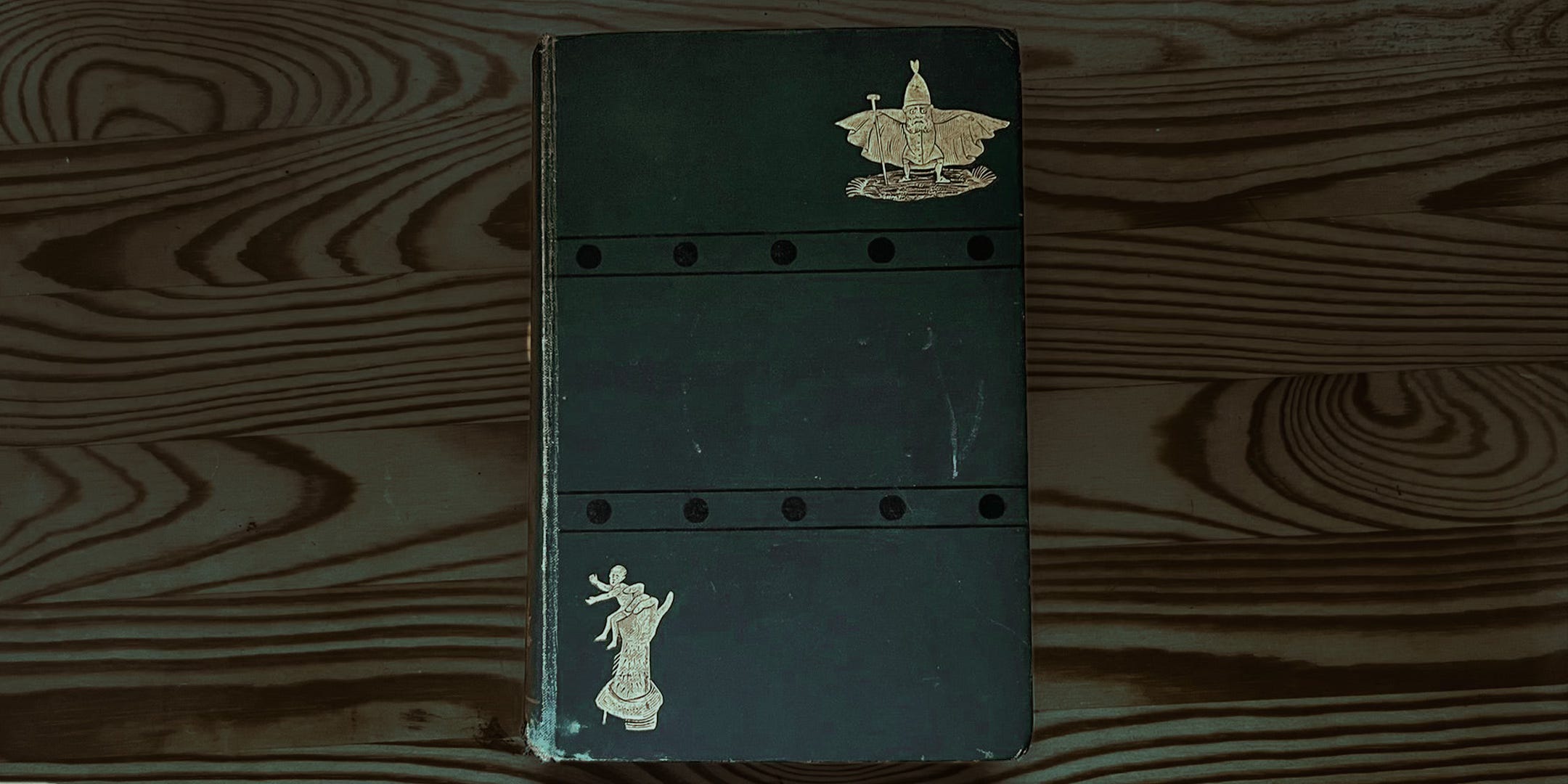
It sat there on the shelf, its spine the colour of enchanted forests, its title radiant in gold foil accompanied by a circle of fairfolk in joyous dance below. I’m not sure how it arrived in our house, only that my father was deeply interested in the ancient sites of old Cornwall, and I have a nebulous recollection that it may have come from a friend who sold books to Hay-on-Wye.
I wasn’t yet fifteen turns about the sun, and for all intents and purposes, I should’ve been interested in plenty more than a worn book, but from the moment I opened its ragged, foxed and yellowed pages, I was enchanted, taken with the fairies, transported to another realm. The folklore collected from Hunt’s rather long ‘walk’ around Cornwall was, and still is, utterly intoxicating.
The book in question is Popular Romances of the West of England by Robert Hunt, and from that very moment, Cornwall lived and breathed. Instead of that lonely cove or that barren hill near the village of my birth, there was that place where the little folk dwelt, that cove where mermaids pulled unsuspecting sailors to their doom, that road where a curmudgeonly giant seized hefty tolls. Unseen currents ran strong, colours vivid, raging storms alive.

And that was the beginning. The beginning of my love of contemporary and urban fantasy. The beginning of my love of folklore, my love of books, my love of story. It began there, and it never let up. Its thread led me along winding lanes, over bright moors and through the odd cave, right to this moment.
Because one day, many years later, while browsing through Briggs and some compendiums of folklore in a local bookshop, it occurred to me that Hunt’s complete and evocative tome wasn’t here. I couldn’t understand it. It was only later still, after writing my own novels, that I realised it was all in the title.
Popular Romances of the West of England. What does that tell you? Take ‘Romances’ to begin with. The term today implies stories of people falling in love. It also implies fiction. What it most unequivocally doesn’t suggest is folklore. Then take ‘the West of England’. As far as many are concerned, this implies Bristol, Somerset, Dorset, Devon and Cornwall. In no way is it specific to Cornwall. And ‘England’, well, there are plenty who would argue Cornwall isn’t even part of England at all, and that it stands in its own right as one of the six Celtic nations, but I’m not opening that particular can of worms right now.
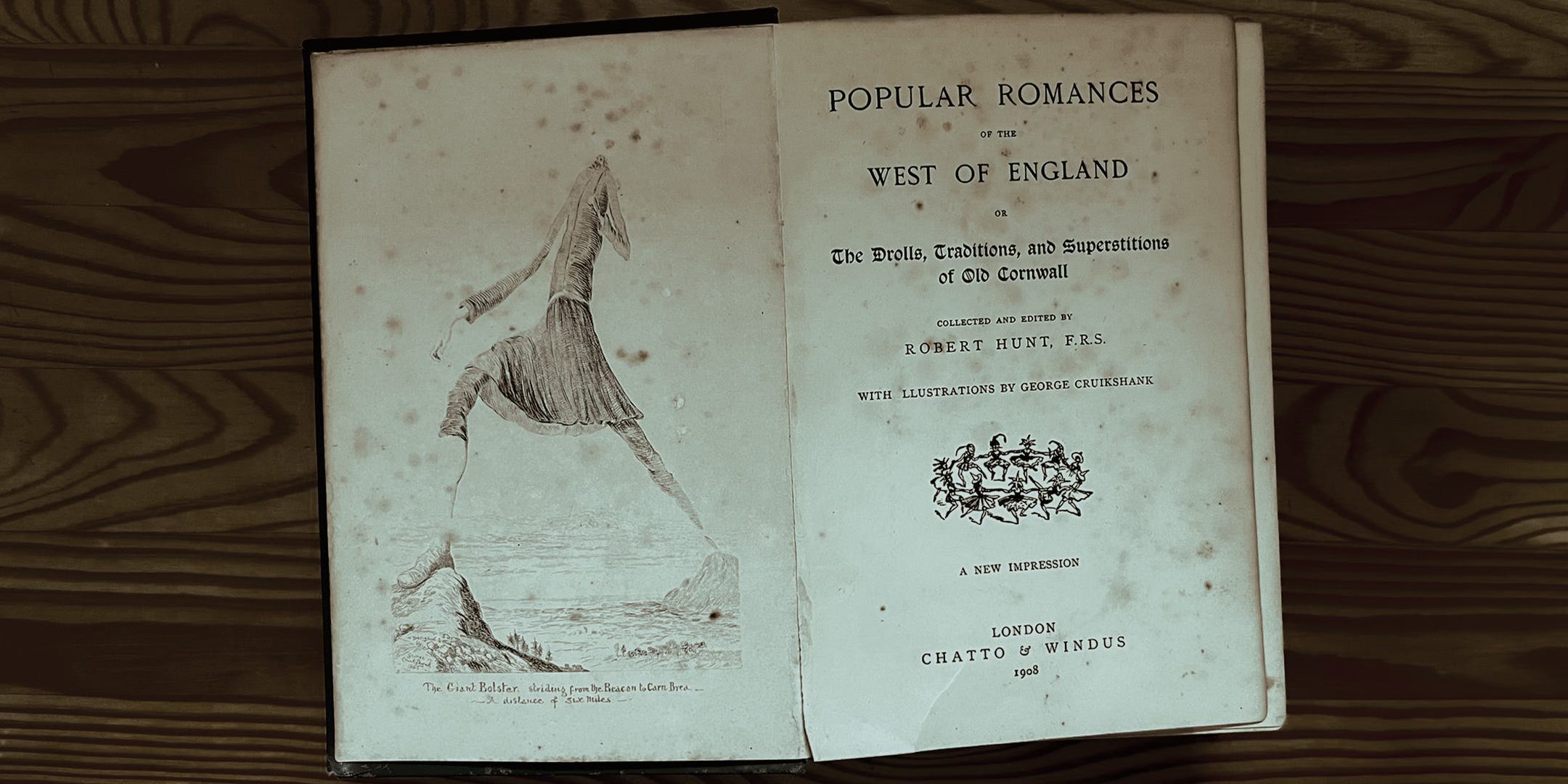
So what we have is a title that translates as Love Stories Set in the West of England. I’m sorry, aren’t we talking folklore here? Isn’t this one man’s magnum opus, a collection of tales as old as time? Isn’t this the recounting of giants and demons, of lost lands and Arthurian quests, of saints that most definitely hold an otherworldly air?
Which brings me to the very modern concept of metadata. Today, the title doesn’t work. Enter ‘Cornish Folklore’ into a standard search, and for years this book wouldn’t appear, though with AI, it’s now showing up more. What hits the first page is typically compendiums, many of them having drawn from Hunt. But not this book. Not this complete, supreme, inimitable collection.
If you root about a little harder, using the original title, you may find that thankfully, it’s on Project Gutenberg for posterity. Because of this, it has been reproduced, but I use the term lightly. Facsimiles of the first edition have been jostled into ebooks and print editions that are barely legible. There’s an ebook version on Gutenberg too that’s doing the rounds, but it’s only the second part, and the copies on Amazon have been titled inaccurately, implying they’re the whole thing (Popular Romances was originally published in two series).
No care. No love. No folklore beneath the skin. No moon-lit, pisky-led, pasty-fuelled passion. No fairy-blindness for anything but the old lore. Just the chance of a quick buck in a cheap wrapper.
To the best of my knowledge, the collection hasn’t been edited since Hunt’s amendments of the third edition in 1881, when it was revised and enlarged, which makes reading a little hard going at times. After all, it’s been a hundred and forty years. And that tugged at the thread—the one that unravelled all that time ago, that wound through my life to include writing and art and editing and publishing, and led me all the way to a very special project today.
Late lamp-lit nights and early sun-spilled mornings, I’m at my desk in deepest West Cornwall, my study window revealing the sweep of fields for the span of a mile before they dip and fold at Penberth Cove. For the first time since its publication, I’m editing Hunt’s tome with reverence.
Hunt’s language itself is not a problem. It’s as remarkable and evocative today as it ever was. But the formatting and typesetting are drowning in Victorian-osity. There was a thing going around TikTok where authors were blacklisted for using em dashes (—), slating their work as AI generated because of them. One look at Popular Romances casts that notion into the flames. Victorian punctuation revelled in them. They were brandished like swords that speared readers’ eyes in every single sentence, and that was after the poor folk were shackled at the wrists and ankles by countless colons and strangled by page-long paragraphs. Though that was the norm for the time, so I doubt there were complaints. But for us today, the remarkable folklore and Hunt’s inimitable voice are obstructed by the usage of its time.
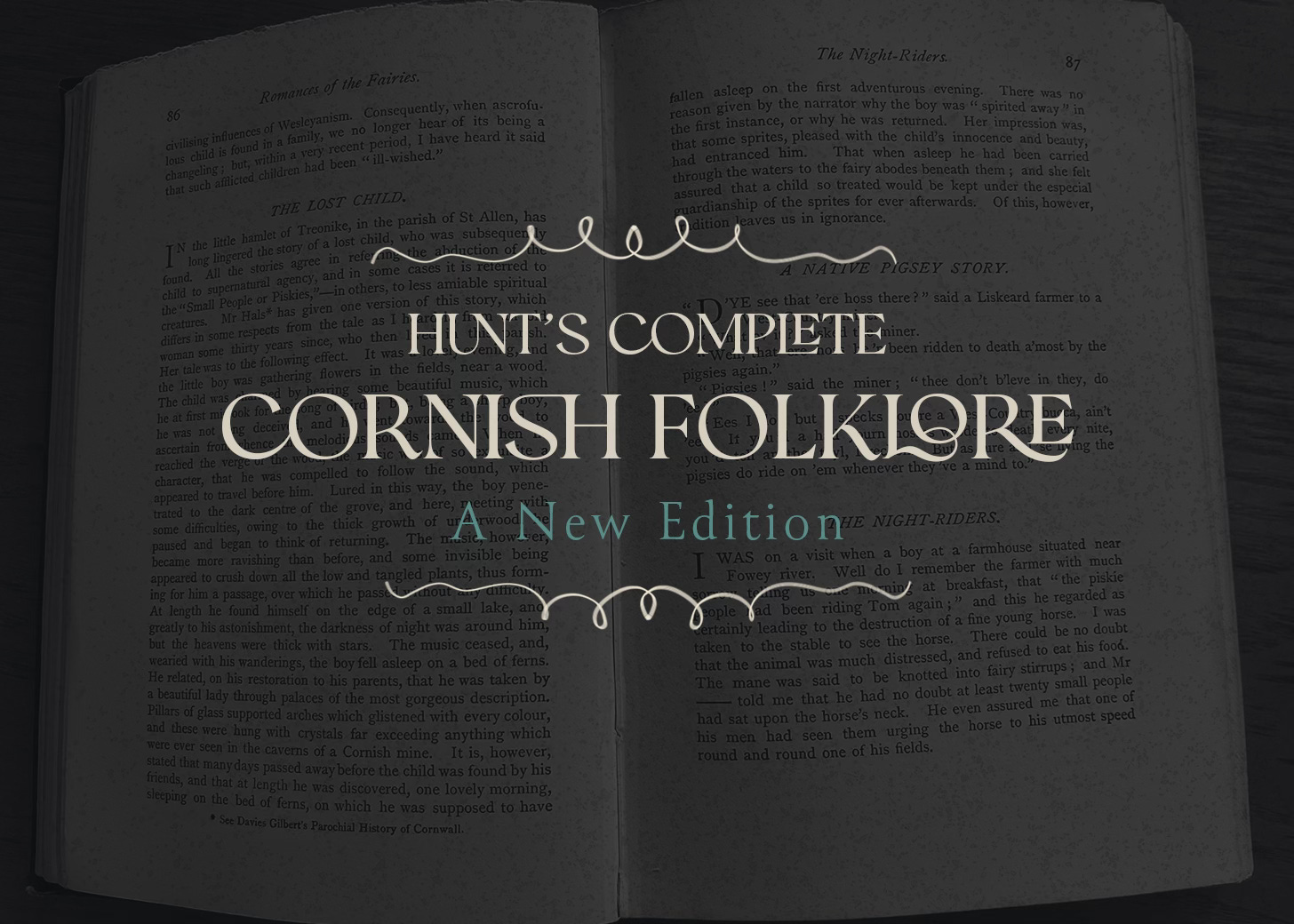
And so my work in progress (at least one of them—my fiction also calls regularly) is preparing a new edition of Popular Romances, retitled Hunt’s Complete Cornish Folklore, so it can be found easily and identified for what it is. This version flows with modern punctuation and formatting, yet completely preserves Hunt’s style and voice. It is comprehensible to modern readers, including those with accessibility needs. It is an edition that will be cherished for years to come, framed within a beautiful, illustrated, foiled hardback (so it glimmers like the original), one that can be enjoyed and gifted and loved.
I’ll be launching it as a special edition on Kickstarter before it’s published in other formats elsewhere, but for now, I’ll be detailing my journey as I delve into old Cornwall and Hunt’s world, dropping extracts and impressions as I grow closer to Hunt with every word.
I’d love for you to join me, so we can continue this journey over the wild moorland down to the storm-lashed sea together.
Cornwall calls you too, my friend.

My publication The Cave Under the Mountain is free for all. But if you do want to support my work, you are most welcome, and it is truly appreciated.